Vaxtaverkir
Exhibition Design
An Exhibition on the History of Schooling
Vaxtaverkir (Growing pains) is an exhibition about the history of children’s education in Reykjavík, designed by ÞYKJÓ for Árbæjarsafn.
Today, most people in Iceland think it’s a given that every child goes to school — it’s almost unthinkable that this wasn’t always the case. But the truth is, it wasn’t so long ago that education became a fundamental right for children in Iceland. How did that shift actually happen? The story is told in full color using precious museum pieces, photographs, and stories from the past, brought vividly to life for a new generation. Created in collaboration and conversation with children under the umbrella of Krakkaráð ÞYKJÓ, the exhibition opened on DesignMarch and Children’s Culture Festival on the first day of summer, April 25, 2024.
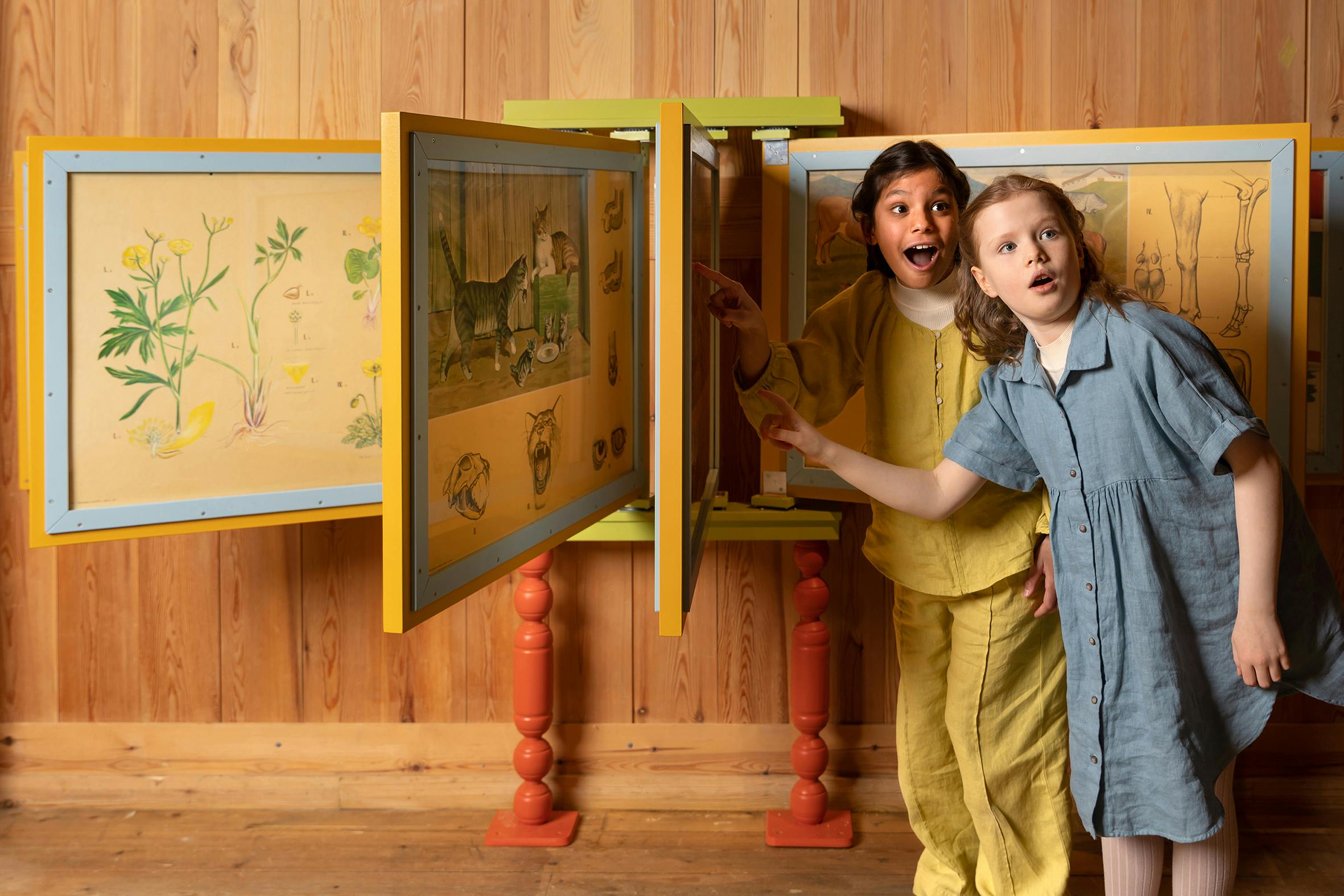
The designers at ÞYKJÓ drew inspiration straight from the museum’s collection: old-school color schemes from classroom posters, quirky fonts from textbooks, and those signature line drawings in instructional books. An unexpected artifact, a vintage candy wrapper, made its way into the process — and instantly captured the project’s sense of fun and nostalgia. That wrapper became a muse for how text, color, and illustration could dance together in the design of the exhibition.
The designers approached Kornhúsið, the museum space, from a slightly different angle than your average gallery space. As one of Árbæjarsafn’s oldest buildings, it was important that the exhibition matched the house’s proportions and didn’t dominate the space. The creative team used bold colors on the exhibition elements as a playful contrast to all the warm wood surrounding them.
Curious children
The immersive design was crafted, first and foremost, from watching kids explore: How could a single photo, a personal story, and an artifact combine to spark real curiosity? When building the exhibition, sustainability and environmental care were top priorities, as well as putting the craft know-how of the Árbæjarsafn staff to good use. Accessibility was also key — the exhibition was literally and figuratively designed with kids in mind (and at their eye level).
Curious children
The immersive design was crafted, first and foremost, from watching kids explore: How could a single photo, a personal story, and an artifact combine to spark real curiosity? When building the exhibition, sustainability and environmental care were top priorities, as well as putting the craft know-how of the Árbæjarsafn staff to good use. Accessibility was also key — the exhibition was literally and figuratively designed with kids in mind (and at their eye level).
Academic Subjects
The tools and textbooks used in grade schools changed dramatically over the 20th century. This evolution is written all over the illustrated classroom posters, typewriters, and glorious film projectors found in the collection. At first, the main reading textbook was the New Testament — but the one everyone remembers is the picture-book hit Gagn og gaman, printed over 200,000 times.
Academic Subjects
The tools and textbooks used in grade schools changed dramatically over the 20th century. This evolution is written all over the illustrated classroom posters, typewriters, and glorious film projectors found in the collection. At first, the main reading textbook was the New Testament — but the one everyone remembers is the picture-book hit Gagn og gaman, printed over 200,000 times.
Practical Subjects
Most surviving artifacts from the history of children’s schooling relate to arts and crafts education. These items shed light on the gender divides in the old school system — back when girls did needlework to prepare for a life as housewives, and boys learned woodworking so they could build furniture and get handy around the house.
Practical Subjects
Most surviving artifacts from the history of children’s schooling relate to arts and crafts education. These items shed light on the gender divides in the old school system — back when girls did needlework to prepare for a life as housewives, and boys learned woodworking so they could build furniture and get handy around the house.
Public Health
The exhibition casts a spotlight on public health in the school system. When Miðbæjarskólinn was founded, it was the first time kids from all walks of life were brought together under one roof. We share firsthand stories — like being dosed with cod liver oil in the middle of a lesson and the eternal struggle against head lice, which, let's be honest, is a battle that's lasted from then till now.
Public Health
The exhibition casts a spotlight on public health in the school system. When Miðbæjarskólinn was founded, it was the first time kids from all walks of life were brought together under one roof. We share firsthand stories — like being dosed with cod liver oil in the middle of a lesson and the eternal struggle against head lice, which, let's be honest, is a battle that's lasted from then till now.
Collaboration
The prep work started back in 2019, when project managers catalogued, cleaned, packed, and photographed items linked to children’s formal education. At the same time, the team dived into research on the history of children’s schooling in Reykjavík during the 19th and 20th centuries. The exhibition is built on research conducted by experts from Borgarsögusafn and reinforces Árbæjarsafn’s role as a leading force in collecting and presenting material culture related to children and children’s culture.
Exhibition committee: Birna Ásgeirsdóttir, Hróðný Kristjánsdóttir, Ingibjörg Áskelsdóttir and Íris Gyða Guðbjargardóttir.
Exhibition curator: Íris Gyða Guðbjargardóttir.
Collaboration
The prep work started back in 2019, when project managers catalogued, cleaned, packed, and photographed items linked to children’s formal education. At the same time, the team dived into research on the history of children’s schooling in Reykjavík during the 19th and 20th centuries. The exhibition is built on research conducted by experts from Borgarsögusafn and reinforces Árbæjarsafn’s role as a leading force in collecting and presenting material culture related to children and children’s culture.
Exhibition committee: Birna Ásgeirsdóttir, Hróðný Kristjánsdóttir, Ingibjörg Áskelsdóttir and Íris Gyða Guðbjargardóttir.
Exhibition curator: Íris Gyða Guðbjargardóttir.
Krakkaráð
Groups of school children joined Krakkaráð ÞYKJÓ with visits to Árbæjarsafn. Pupils aged 6–12 were invited on field trips and workshops with designers, historians, conservators, and the Borgarsögusafn education team. Kids had the chance to join the conversation and cross-disciplinary collaboration — as bona fide experts on being grade-schoolers. These visits played a real part in shaping the exhibition. The kids helped choose which artifacts made the cut, and the designers based the interactive exhibition design directly on what they observed during these kid-powered reviews.
Krakkaráð
Groups of school children joined Krakkaráð ÞYKJÓ with visits to Árbæjarsafn. Pupils aged 6–12 were invited on field trips and workshops with designers, historians, conservators, and the Borgarsögusafn education team. Kids had the chance to join the conversation and cross-disciplinary collaboration — as bona fide experts on being grade-schoolers. These visits played a real part in shaping the exhibition. The kids helped choose which artifacts made the cut, and the designers based the interactive exhibition design directly on what they observed during these kid-powered reviews.
Vaxtaverkir
Exhibition Design
An Exhibition on the History of Schooling
Vaxtaverkir (Growing pains) is an exhibition about the history of children’s education in Reykjavík, designed by ÞYKJÓ for Árbæjarsafn.
Today, most people in Iceland think it’s a given that every child goes to school — it’s almost unthinkable that this wasn’t always the case. But the truth is, it wasn’t so long ago that education became a fundamental right for children in Iceland. How did that shift actually happen? The story is told in full color using precious museum pieces, photographs, and stories from the past, brought vividly to life for a new generation. Created in collaboration and conversation with children under the umbrella of Krakkaráð ÞYKJÓ, the exhibition opened on DesignMarch and Children’s Culture Festival on the first day of summer, April 25, 2024.
The designers at ÞYKJÓ drew inspiration straight from the museum’s collection: old-school color schemes from classroom posters, quirky fonts from textbooks, and those signature line drawings in instructional books. An unexpected artifact, a vintage candy wrapper, made its way into the process — and instantly captured the project’s sense of fun and nostalgia. That wrapper became a muse for how text, color, and illustration could dance together in the design of the exhibition.
The designers approached Kornhúsið, the museum space, from a slightly different angle than your average gallery space. As one of Árbæjarsafn’s oldest buildings, it was important that the exhibition matched the house’s proportions and didn’t dominate the space. The creative team used bold colors on the exhibition elements as a playful contrast to all the warm wood surrounding them.
Curious children
The immersive design was crafted, first and foremost, from watching kids explore: How could a single photo, a personal story, and an artifact combine to spark real curiosity? When building the exhibition, sustainability and environmental care were top priorities, as well as putting the craft know-how of the Árbæjarsafn staff to good use. Accessibility was also key — the exhibition was literally and figuratively designed with kids in mind (and at their eye level).
Curious children
The immersive design was crafted, first and foremost, from watching kids explore: How could a single photo, a personal story, and an artifact combine to spark real curiosity? When building the exhibition, sustainability and environmental care were top priorities, as well as putting the craft know-how of the Árbæjarsafn staff to good use. Accessibility was also key — the exhibition was literally and figuratively designed with kids in mind (and at their eye level).
Academic Subjects
The tools and textbooks used in grade schools changed dramatically over the 20th century. This evolution is written all over the illustrated classroom posters, typewriters, and glorious film projectors found in the collection. At first, the main reading textbook was the New Testament — but the one everyone remembers is the picture-book hit Gagn og gaman, printed over 200,000 times.
Academic Subjects
The tools and textbooks used in grade schools changed dramatically over the 20th century. This evolution is written all over the illustrated classroom posters, typewriters, and glorious film projectors found in the collection. At first, the main reading textbook was the New Testament — but the one everyone remembers is the picture-book hit Gagn og gaman, printed over 200,000 times.
Practical Subjects
Most surviving artifacts from the history of children’s schooling relate to arts and crafts education. These items shed light on the gender divides in the old school system — back when girls did needlework to prepare for a life as housewives, and boys learned woodworking so they could build furniture and get handy around the house.
Practical Subjects
Most surviving artifacts from the history of children’s schooling relate to arts and crafts education. These items shed light on the gender divides in the old school system — back when girls did needlework to prepare for a life as housewives, and boys learned woodworking so they could build furniture and get handy around the house.
Public Health
The exhibition casts a spotlight on public health in the school system. When Miðbæjarskólinn was founded, it was the first time kids from all walks of life were brought together under one roof. We share firsthand stories — like being dosed with cod liver oil in the middle of a lesson and the eternal struggle against head lice, which, let's be honest, is a battle that's lasted from then till now.
Public Health
The exhibition casts a spotlight on public health in the school system. When Miðbæjarskólinn was founded, it was the first time kids from all walks of life were brought together under one roof. We share firsthand stories — like being dosed with cod liver oil in the middle of a lesson and the eternal struggle against head lice, which, let's be honest, is a battle that's lasted from then till now.
Collaboration
The prep work started back in 2019, when project managers catalogued, cleaned, packed, and photographed items linked to children’s formal education. At the same time, the team dived into research on the history of children’s schooling in Reykjavík during the 19th and 20th centuries. The exhibition is built on research conducted by experts from Borgarsögusafn and reinforces Árbæjarsafn’s role as a leading force in collecting and presenting material culture related to children and children’s culture.
Exhibition committee: Birna Ásgeirsdóttir, Hróðný Kristjánsdóttir, Ingibjörg Áskelsdóttir and Íris Gyða Guðbjargardóttir.
Exhibition curator: Íris Gyða Guðbjargardóttir.
Collaboration
The prep work started back in 2019, when project managers catalogued, cleaned, packed, and photographed items linked to children’s formal education. At the same time, the team dived into research on the history of children’s schooling in Reykjavík during the 19th and 20th centuries. The exhibition is built on research conducted by experts from Borgarsögusafn and reinforces Árbæjarsafn’s role as a leading force in collecting and presenting material culture related to children and children’s culture.
Exhibition committee: Birna Ásgeirsdóttir, Hróðný Kristjánsdóttir, Ingibjörg Áskelsdóttir and Íris Gyða Guðbjargardóttir.
Exhibition curator: Íris Gyða Guðbjargardóttir.
Krakkaráð
Groups of school children joined Krakkaráð ÞYKJÓ with visits to Árbæjarsafn. Pupils aged 6–12 were invited on field trips and workshops with designers, historians, conservators, and the Borgarsögusafn education team. Kids had the chance to join the conversation and cross-disciplinary collaboration — as bona fide experts on being grade-schoolers. These visits played a real part in shaping the exhibition. The kids helped choose which artifacts made the cut, and the designers based the interactive exhibition design directly on what they observed during these kid-powered reviews.
Krakkaráð
Groups of school children joined Krakkaráð ÞYKJÓ with visits to Árbæjarsafn. Pupils aged 6–12 were invited on field trips and workshops with designers, historians, conservators, and the Borgarsögusafn education team. Kids had the chance to join the conversation and cross-disciplinary collaboration — as bona fide experts on being grade-schoolers. These visits played a real part in shaping the exhibition. The kids helped choose which artifacts made the cut, and the designers based the interactive exhibition design directly on what they observed during these kid-powered reviews.